My internship at OB Beer
I wanted to see how the data analysis I’d learned in class is actually used inside a company. So even though finals, my capstone and certification prep all landed at once, I applied for the university internship at AB InBev Korea (OB Beer). Now that the internship is wrapping up, here’s how it came together, from deciding to apply to the cover letter and the interview.
- Company
- AB InBev Korea (OB Beer)
- Program
- University internship for credit
- Team
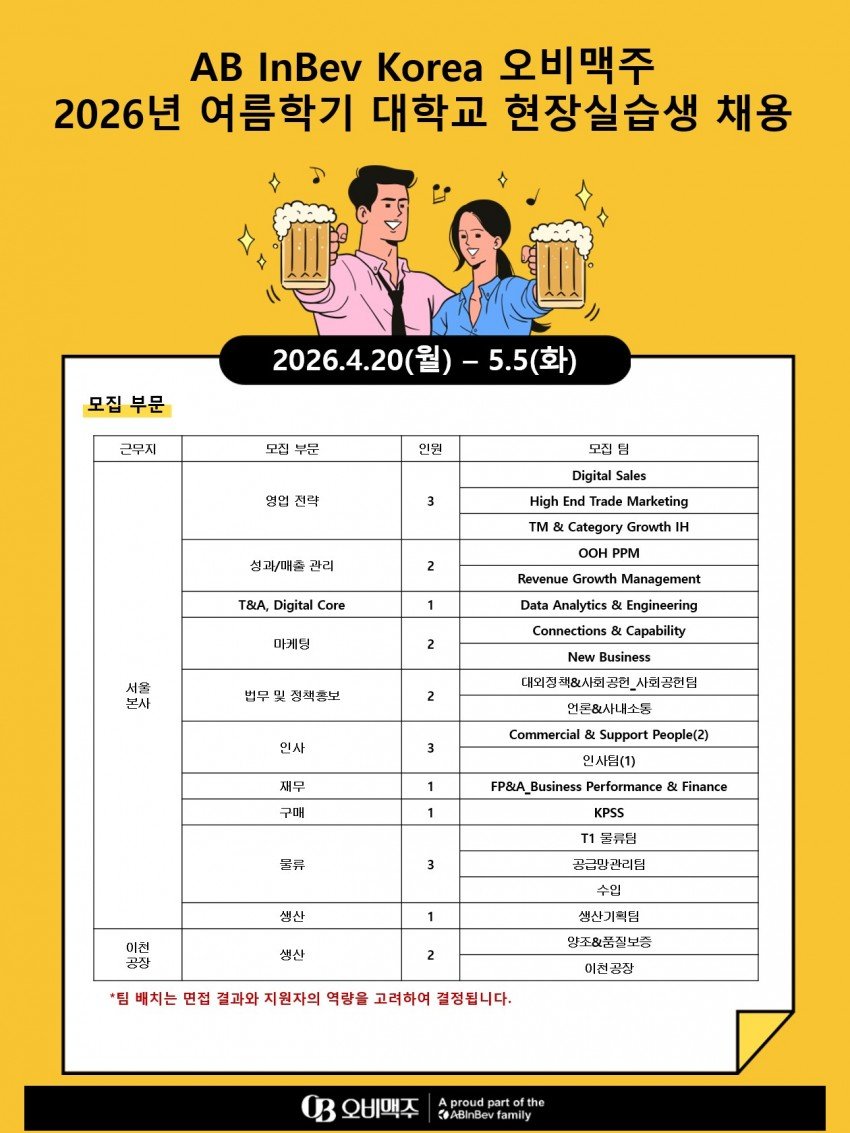
- T&A Digital Core
- Role
- Data Analytics & Engineering
- Period
- Summer session and fall semester, 2026
- Location
- ASEM Tower, Gangnam, Seoul
The program
In Korea, many universities partner with companies so students can get real work experience before they graduate, and earn credit for it. At my school, a summer or winter placement counts for 6 credits and a full-semester placement for 15. I did the summer session and then stayed on through the fall semester.
One thing worth knowing: most of these placements go through the school, which forwards your application to the company. OB Beer is different. You apply directly on the OB Beer careers site. If you’re interested, don’t just wait for a notice from your school. Keep an eye on the careers site too.
Why this company
It started with a recommendation. In my second year, I did a team project in a machine learning class with a senior student, and by coincidence the dataset was about wine. I really looked up to that senior, who told me, “The work is a bit tough, but you learn a lot.” That stuck with me. I decided I would intern at OB Beer, however many tries it took.
In my cover letter, I also wrote about why OB Beer’s data interested me. Beer demand swings hard between the summer peak and the off-season, and buying patterns differ by channel, from convenience stores and supermarkets to bars and restaurants. On top of that, brands with very different positioning, like Cass and Hanmac, are sold by the same company, so the same shift in demand can mean something different for each brand. After working with clean datasets in the lab, I wanted to handle real data where seasons and channels are tangled together.
Why this role
In my data science program, I did plenty of team projects, but when we split up the work, one person usually ended up handling both the analysis and the engineering. So I couldn’t clearly explain how a data analyst’s job differs from a data engineer’s.
That question got sharper during my undergraduate research on anomaly detection for tabular data. However carefully I designed a model, I couldn’t trust the results when the input data was poor. At first I thought the answer was a better algorithm. The longer I worked on it, the more I came to see that data comes before the model. I believe a model’s performance only means something once you understand how its data is created and what standards it’s managed by.
That’s why I applied for the Data Analytics & Engineering role. I wanted to see for myself how data quality problems are handled in practice.
I worked on the BEES T&A Digital Core team. BEES is AB InBev’s B2B ordering app, used by business customers rather than consumers to order beer. So the data I worked with wasn’t about factories or logistics. It was sales data from wholesale trade.
The application
The cover letter had four questions. It was the first internship I’d ever applied for, so I kept AI help to a minimum and wrote about my experience in my own words. Here’s what I covered in each answer.
Q1. Why OB Beer
The first question asked why I was applying. I opened with my anomaly detection research and how it led me to “data before the model,” and framed the internship as a chance to find answers to that question in the field. Then I explained why OB Beer in particular: beer data is shaped by seasonality and sales channels, and the company feeds price elasticity analysis and demand forecasts into its sales and marketing strategy. I closed with my goal of becoming a data scientist who helps sales and marketing make better decisions with data.
Q2. Strengths and areas to grow
I wrote about two strengths. The first is understanding what people need before anything else. In CodersCUK, a coding club at my university, I planned a range of curricula: a barrier-free kiosk class for middle school students, a Python data analysis class, and mentoring for high school students building AI agents. Before each class, I started by figuring out where learners would get stuck. I saw this as close to the work of turning other teams’ requests into data structures.
The second is solving problems with data. In CUK-MDA Cup, a machine learning project in my multivariate data analysis class, I built a model that sorted weather into five classes from 15 weather variables. I compared Random Forest, XGBoost and LightGBM with cross-validation, kept improving the model against the leaderboard, and used feature importance to find the key variables. I finished 3rd out of 110 (accuracy 0.789).
For my area to grow, I was honest that I had no real experience in a company setting. I had worked with data in research and teaching, but I had never had to judge a data quality issue inside a pipeline tied to business decisions.
Q3. A memorable experience
For the third question, I wrote about a reusable cup campaign I joined as a crew member, run with the local city government. The goal was to build a habit of returning reusable cups at four local universities, and when we started, the return rate was only 42.80%.
To find out why, I watched what actually happened on campus. There were many exchange and international students, and our Korean-only promotion wasn’t reaching them. I suggested bringing international students onto the crew so we could promote the campaign in several languages. I also asked the collection company for return data from all four schools, visualized it in Python every week, and posted it on Instagram. Instead of showing the current ranking, we showed specific numbers like “just a few more returns to take first place,” and participation rose noticeably. I also looked at the routes students took leaving campus and moved the return bins to match. By April 2025, the return rate had reached 95%.
I wrote that this taught me to read data in the context of the place it comes from, and that the same data can change how people act depending on how you present it.
Q4. What I want to learn
I named two things I wanted to learn. The first was a feel for working with data at real scale. I had passed SQLD, Korea’s SQL certification, but I had never designed or tuned SQL against a large production database. I wanted to see firsthand how data is stored and moves through an ETL pipeline.
The second was how to judge data quality in a business context. Say orders suddenly spike just before peak season. Is that a data error, or are wholesale customers ordering ahead? You can only tell if you know how beer sells. Because the meaning of an anomaly is set by the business context, I wrote that I wanted to learn those standards by taking part in QA and in validating model outputs.
The interview
My interview date clashed with a national IT certification exam. Looking back, that was a bold thing for an applicant to bring up, but I explained the situation honestly, and the company kindly moved my interview to the afternoon, after the exam. It was a two-on-one interview on Microsoft Teams.
These are the questions I remember:
- Introduce yourself and tell us why you applied
- Walk us through a project from your cover letter
- Have you thought about how this project could be applied on the job?
Looking back
When I applied, finals and my capstone were happening at the same time, and I honestly thought it couldn’t be done. Certification prep was on top of that, and it was a hard stretch to get through on my own. I applied anyway because I couldn’t picture how the work I was putting in would be used in the real world, and I wanted to see it for myself.
At the end of my cover letter, I wrote that my goal was for the way I see and interpret data to have changed by the time the internship ended. Now I’m wrapping up, putting together a presentation for the team and a handover for the next intern.
I’m heading out into the working world with happy memories of the people I worked with and my fellow interns. My first real job is something I’ll remember for a long time.
Comments